
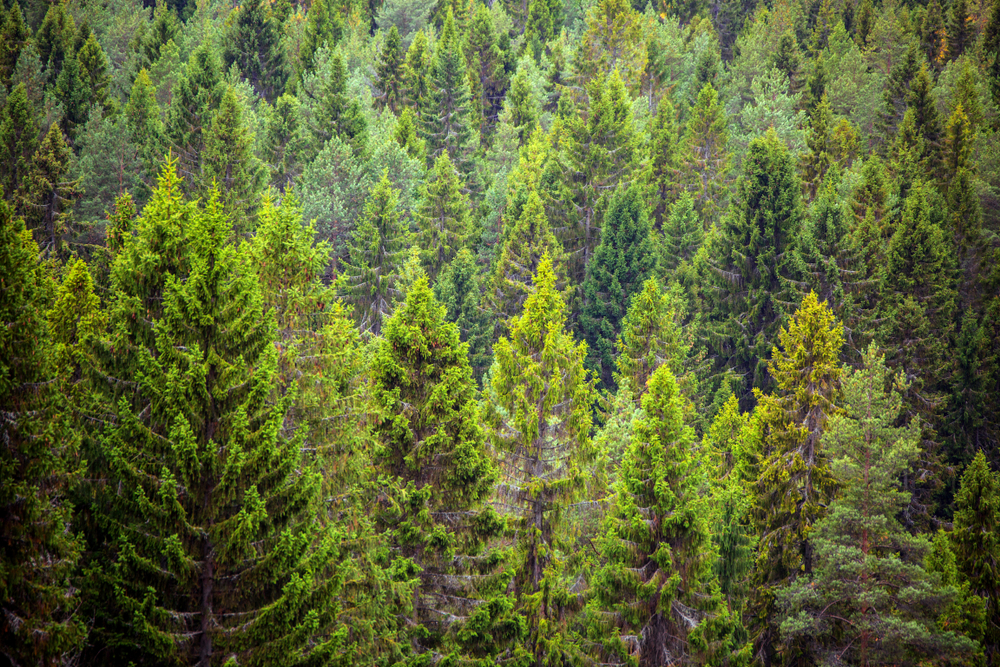
As any kindergartner will tell you, fall is called “fall” because the leaves on the trees change color and fall off their branches. So if that’s the case, then why do some trees keep their leaves year-round? The evidence can be found every December in living rooms all over the world. Christmas trees famously keep their green foliage all year long, so they are included in the class of trees known as “evergreens.”
What is an evergreen tree?
Simply put, an evergreen tree stays green during the fall and keeps its leaves during the winter. Most species of conifer trees, such as pine, juniper, and spruce trees, are evergreen trees. The opposite of an evergreen tree is a “deciduous” tree. Deciduous trees exhibit changing colors in the fall and shed their leaves in the winter. Oak, maple, and elm are some examples of deciduous trees. In the fall, these trees turn red, orange, or yellow, and they’ll slowly lose their leaves until the winter.
How do they stay green?
All trees get energy for growth through photosynthesis. Through this process, they can turn water, carbon dioxide, and sunlight into food. There are fewer daylight hours in the fall and winter, so there are fewer opportunities for trees to make energy from sunlight. To counteract this, deciduous trees drop their flat, broad leaves and go dormant to conserve energy until the spring, when they grow new leaves to absorb the coming, plentiful sunlight.
Unlike deciduous trees, evergreens are able to keep their leaves because of their unique, needle-like shape, which helps to conserve water. The leaves are also coated in a waxy substance that prevents water loss through evaporation. Because of the leaves’ shape and waxy coating, evergreens don’t need to conserve more energy in the winter. Thus, the leaves stay green, and there’s no need for the tree to shed leaves or go dormant.

The bottom line
Like animals, trees have evolved to survive through the winter in their own way. The process of losing leaves in the fall is vital to the survival of a deciduous tree. At the same time, evergreens must keep their leaves for the same reason. The unique biology of evergreen trees makes them resilient, allowing them to thrive in very harsh environments. Regardless of whether a tree loses or keeps its leaves in the winter, we are all fortunate to be able to observe so much variety among the flora surrounding us.